Yes. Replacement windows can go in during a New Hampshire or Massachusetts winter. Done one opening at a time, each room is open to the cold only while its window is being swapped.
What changes in winter is the planning. The sealant and foam have to suit the temperature, and surfaces have to be free of ice and frost. The first cold mornings afterward may also bring some condensation. Here is how it works, and what to plan for.
How A Winter Window Install Works
A replacement window does not usually mean tearing the wall open. Harvey’s replacement window installation guide lays out the steps. The installer removes the inside trim and stops, then sets the new window into the existing opening, tight against the old blind stops.
Before the window goes in, a heavy bead of sealant (ASTM C920 certified) runs along the inside of the blind stops. After the window is fastened and squared, the gap between frame and opening is insulated. Harvey allows low expanding foam as an alternative to fiberglass, installed according to the foam maker’s instructions.
In winter, the sensible way to do this is one opening at a time. The old sash comes out, and the new window goes in, sealed and insulated, before the next opening is started. Ask any installer you talk to whether they work this way.
Storage matters too. Harvey says windows should be stored upright, off the ground, and out of the weather in a clean, dry area. In January, that means a garage or a dry room, not a snowbank.
What Cold Weather Means For Sealant And Foam
Not every sealant handles the cold the same way, so the product on the truck matters. One example is OSI QUAD Max, a window, door and siding sealant. Its data sheet lists an application range of 0°F to 140°F. For easier use in the cold, its maker says to store the cartridge at room temperature for at least 24 hours first.
The same data sheet says surfaces must be clean and dry, with any ice, snow or frost removed. Its cure time is listed as 24–72 hours and depends on temperature, humidity and bead depth. So a frosty frame gets cleared before sealant goes on, and an icy morning can push the start time.
Spray foam is fussier. DuPont says GREAT STUFF Window & Door foam gives the best results when the product is 60–90°F. That is the can’s temperature, so in winter the cans should stay warm until they are used. DuPont describes it as minimally expanding and proven not to bow window or door frames when properly installed.
The fair question for any installer: which sealant and foam will you use, and what temperatures are they rated for?
Winter Install Vs Warm-Weather Install
| What Matters | Winter | Spring And Summer |
|---|---|---|
| Finding drafts | Cold air makes leaky windows easy to feel | Leaks are harder to notice |
| Sealant | Must be rated for the cold; ice, snow and frost cleared first | Surfaces still need to be clean and dry |
| Spray foam | Cans kept warm, since it works best at 60–90°F product temperature | Easier to keep in range |
| While a window is out | Cold air comes into that room | Little comfort impact |
| After the install | Inside condensation may show on cold mornings | Inside glass stays warmer, so less condensation |
| When you feel the benefit | This heating season | Next heating season |
Why Winter Can Be A Good Time
You can feel the problem. The U.S. Department of Energy notes that air leaks around windows and doors are the most obvious ones in a house. It also says air leaks make a home drafty and strain heating equipment. On a cold day, walk the house and note which windows feel drafty, rattle or frost up. That list is useful at your quote. Our guide to the signs you need new windows can help.
You get the benefit now. A window replaced in January starts working this heating season, not next. If the tight budget is the reason to wait, financing through Synchrony runs 0% for 18 months, with payments as low as $87/month*. *Rates and terms dependent on qualifying credit.
The quote does not depend on the weather. Our free in-home measure happens inside your house. You get a written quote with no pressure, whatever the weather is doing outside.
What To Plan For
- Clear a path inside. Move furniture, curtains and blinds away from each window.
- Clear snow and ice below the windows outside where it is safe to do so, so the exterior can be reached.
- Keep pets and children out of each room while its window is out.
- Expect a cool room for a short stretch. Close the door to that room if you can.
- Allow for a storm day moving the schedule, since ice and frost must come off before sealant goes on.
- Watch indoor humidity for the first few weeks.
That last point surprises people. Harvey’s condensation sheet explains that old, drafty windows let indoor moisture escape along with the heat. Tight new windows do not, so you may notice more condensation than before. Harvey says condensation on the inside glass is not a sign of seal failure. Fogging between the panes that you cannot wipe away could be.
Harvey’s suggested fixes are simple: exhaust fans in the kitchen, bathrooms and laundry, dryers vented outside, and a dehumidifier if needed.
If winter comfort is the goal, the glass package matters. The Harvey Homerun is triple pane at a .18 U-value, starting at $699 installed. The Gentek Series 9000 is triple pane at a .22 U-value, from $683. The Harvey Classic, our best seller, is dual pane at a .24 U-value, from $617. Our guide to double pane vs triple pane windows compares them honestly. Every window carries our transferable Lifetime Warranty, whatever the season. Wondering about rebates first? See our 2026 rebate and tax credit guide.
Frequently Asked Questions
Is it too cold to install windows in winter?
It depends more on the materials than the calendar. One common window sealant, OSI QUAD Max, is rated for application from 0°F to 140°F. Ask your installer what their sealant and foam are rated for.
Will my house get cold while the windows are replaced?
A room is open to outside air only while its window is being swapped, if the installer works one opening at a time. Ask your installer to confirm that before the job starts, and close the door to that room if you can.
Why are my new windows fogging up on the inside?
Harvey explains that tight new windows no longer let indoor moisture escape the way drafty ones did. Condensation on the inside glass is not a seal failure, but fogging between the panes that you cannot wipe away could be.
Can I get a quote for new windows in the winter?
The free in-home measure happens inside your house, and you get a written quote with no pressure. Call (603) 764-7212, Monday to Friday 8:00 to 5:00, to book one.
Should I wait until spring to replace my windows?
Not if the materials suit the cold and the work goes one opening at a time. If a window is failing now, waiting means another season of drafts. If you would rather avoid storm-day rescheduling, spring is a fine choice too.
Cold weather is the best time to see which windows are failing you. Book a free in-home quote and we will measure every opening and put the price in writing. Every window is measured, ordered and installed by our own local crew. Skip, Andrea or Gary reads every request, or call (603) 764-7212, Monday to Friday 8:00 to 5:00.
Sources
- Harvey Windows + Doors: Replacement Window Installation Guide (PDF)
- Harvey Windows + Doors: Condensation, Causes and Cures (PDF)
- Henkel: OSI QUAD Max Clear Window, Door and Siding Sealant Technical Data Sheet (PDF)
- DuPont: GREAT STUFF Window and Door Insulating Foam Sealant
- U.S. Department of Energy: Guide to Air Sealing (PDF)
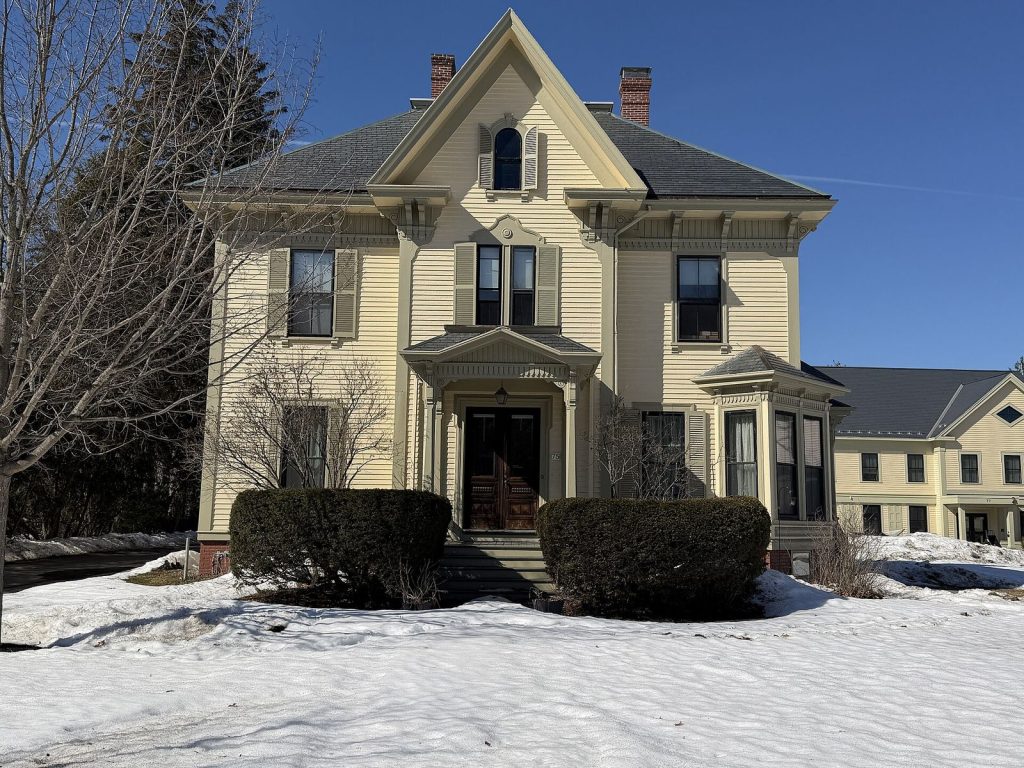
Header photo: Dow House, 75 Front Street, Exeter – March 2026 by AntiCompositeNumber, licensed CC BY-SA 4.0, via Wikimedia Commons.